How to Increase Brand Awareness Through Digital Marketing

Shouting louder inside a hyper-competitive B2B marketplace is no longer an effective customer acquisition strategy. To scale an enterprise organization sustainably, marketing leaders must understand that clarity always outperforms volume. Many brand managers invest thousands of dollars into performance marketing pipelines, search engine networks, and text-heavy social posts. Yet, despite this high ad spend, they remain virtually invisible to their highest-value prospective clients. This invisibility is driven by generic, uninspiring corporate communication structures that lack immediate visual impact. When your market messaging looks identical to your closest competitors, your organic and paid distribution channels completely break down. To break through this digital stagnation, enterprise growth teams must transition toward an omni-channel approach powered by strategic video distribution. Let’s break down how to systematically increase brand awareness through digital marketing by engineering high-converting visual assets. The Digital Noise Crisis: Why Traditional Impressions Are Failing In our experience at ExplainerCue, after working on over 1,500 projects, we have seen that raw digital impressions mean absolutely nothing if your brand elements fail to trigger deep psychological recall. The 3-Second Attention Economy Modern business executives, CTOs, and marketing managers scan their professional feeds at lightning speed. If your digital marketing campaign relies on a dense block of text or a static template, your audience will swipe past before your core value proposition even registers. To turn cold impressions into active brand awareness, you need a dynamic hook. Captivating motion design patterns interrupt the scrolling habits of busy buyers, forcing them to stop, engage, and process your platform’s underlying utility. The Dilution of Stock Imagery Using unoriginal stock photographs or generic graphic design configurations automatically strips your corporate identity of true authority and institutional trust. If your marketing channels look cheap, prospective enterprise clients will naturally assume your software or service portfolio operates with that same lack of sophistication. True brand distinction requires tailored visual property built explicitly for your digital distribution nodes. 3 Visual Pillars to Increase Brand Awareness Through Digital Marketing To effectively increase brand awareness through digital marketing, your content deployment must be divided across three highly structured, premium asset frameworks. [Placeholder: Insert Omni-Channel Brand Awareness Explainer Video Here] [BAAD MAI ADD KERNA HAI: Yahan ek real world omni-channel video case study lagayein jo dikhaye ke kaise ek video asset ko multiple ad formats mein convert kiya jata hai.] To understand how to keep users deeply engaged once they enter your corporate pipeline, review our master strategic analysis on The Power of Video: How SaaS Companies Can Boost Engagement. Measuring Awareness: The Metrics That Actually Matter to CMOs True digital marketing awareness goes far deeper than vanity metrics like raw likes, random shares, or superficial comment counts. High-growth organizations measure performance by tracking tangible user behavior. High Video Play-Through Rates If an executive clicks your digital ad and leaves within two seconds, your brand awareness metric is zero. We look at sustained view velocity—did the user stay through the critical middle-of-the-video sequences where your core market value is delivered? Lift in Branded Organic Search The ultimate proof that you are successfully building brand authority is a measurable spike in users typing your exact agency name into Google. When target accounts skip generic category search terms and look for you directly, your digital marketing engine is winning. The ExplainerCue Blueprint: Engineering High-Authority Brand Presence We never build creative video assets in a vacuum. Our strategic production pipeline ensures your visual narratives line up directly with your conversion optimization goals. Rebuilding Complex System Perceptions If your organization provides intricate backend data architectures, you cannot explain your competitive advantage using basic slides. For a detailed breakdown of alternatives, read our guide on how to build Explainer Videos Using PowerPoint. Our design blueprint strips away the confusing technical jargon and uses premium Isometric Design for Tech Products to build a single, flawless visual landscape where your target buyers can see your entire workflow operate effortlessly. Eliminating User Experience Bottlenecks Every piece of public-facing content you launch must guide the viewer seamlessly toward the lower stages of your conversion funnel. Whether your goal is showcasing a new digital product architecture or helping clients diagnose and resolve catastrophic SaaS Onboarding Mistakes, we build structured visual frameworks that ensure your brand is perceived as an undisputed market authority. [Placeholder: Insert ExplainerCue B2B Brand Lift Metric Chart Here] [BAAD MAI ADD KERNA HAI: Yahan ek data graphic append karein jo dynamic motion graphics campaign ke baad custom brand search lift ka percentages show kare.] To determine exactly how to style these premium digital assets for your next campaign, check out our definitive breakdown on choosing the perfect SaaS Animation Style. Dominate Your Market Category with High-Impact Visual Storytelling Building a highly recognizable corporate brand is not about reaching millions of random people with cheap generic templates. It is about becoming completely unforgettable to the specific enterprise accounts that control your industry’s market share. Using customized motion systems to increase brand awareness through digital marketing instantly bridges the clarity gap, builds institutional confidence, and positions your business as the default choice in your niche. Ready to capture the attention of high-value enterprise accounts? Explore how we articulate the true What Does SaaS Experience Mean: Understanding the Essence of Seamless Software blueprint and Book a Specialized Brand Strategy Audit with ExplainerCue Today to blueprint your platform’s ultimate market breakthrough.
5 Best AI Tools for Video Content Creation (2026 Guide)

The demand for video content has never been higher. Marketing managers, product leads, and tech executives face immense pressure to produce constant streams of visual content to fuel their pipelines. But here is the reality: traditional video production pipelines can be slow and expensive. To bridge this gap, many brands rush to automate everything. They deploy generic AI video tools, expecting immediate conversion spikes. Instead, they hit a wall. They end up with generic, robotic videos that fail to capture their complex product architecture or build brand trust. In our experience at ExplainerCue, after working on over 1,500 projects, we have learned that the secret isn’t replacing human creativity with AI. It is about using specific AI tools to eliminate production bottlenecks while letting professional motion design handle the heavy lifting. Here is how you can strategically use the 5 best AI tools for video content creation without compromising your brand authority. 1. Runway Gen-3: Accelerating Visual Ideation What It Is & Why It Matters Runway Gen-3 represents a massive leap forward in generative video. For B2B marketing teams, it serves as a powerful engine for cinematic asset generation and hyper-realistic concept testing. How to Use It in Your Workflow Instead of using Runway to create a finished product, use it during your pre-production phase. The Conversion Gap While Runway is incredible for atmospheric B-roll, it lacks the precision required to showcase a software interface or an intricate product framework. For high-converting product explainers, generic AI generation must be paired with precise motion design assets that maintain pixel-perfect brand compliance. If you want to see how elite tech firms align their visual style, check out our comprehensive SaaS Animation Style Guide. 2. ElevenLabs: Scalable Voice Synthesis and Localization What It Is & Why It Matters Voiceover production has historically been a significant bottleneck, requiring studio booking, audio editing, and re-recording fees for every minor script iteration. ElevenLabs solves this with hyper-realistic AI voice synthesis. How to Use It in Your Workflow Use ElevenLabs to rapidly iterate during the scriptwriting and storyboarding process. The Conversion Gap An AI voice is only as good as the script it reads and the visuals that back it up. If your voiceover is flawless but your visuals are static, your audience will drop off within the first five seconds. To prevent massive drop-offs right at the start of your user journey, make sure to avoid these critical SaaS Onboarding Mistakes Analysis. 3. Midjourney (V6): Rapid Storyboard Asset Generation What It Is & Why It Matters Midjourney remains the gold standard for high-end AI image generation. In a professional B2B video workflow, it is an invaluable tool for establishing art direction and generating unique design concepts. How to Use It in Your Workflow Use Midjourney to align your internal team on visual direction before investing heavily in animation production. The Conversion Gap Midjourney generates flat, static images. To explain a complex SaaS workflow or a layered tech infrastructure, those assets must be separated, rebuilt, and brought to life. This is where deploying specialized Isometric Design for Tech Products creates absolute clarity, turning static concepts into clear, moving parts that prospects immediately understand. 4. HeyGen: Scaling Top-of-Funnel Personalized Outreach What It Is & Why It Matters HeyGen allows teams to create realistic human avatars that can speak directly to a viewer based on text inputs. This tool is built for high-volume, personalized outreach. How to Use It in Your Workflow Integrate HeyGen into your sales enablement pipeline rather than your main brand awareness campaigns. The Conversion Gap An avatar can say a prospect’s name, but it cannot explain a proprietary database architecture or a complex financial workflow. When a prospect moves past the introduction, they need a deep dive into the product ecosystem. High-conversion optimization requires shifting from a talking head to custom 3D layouts, which you can build using the Best 3D Motion Graphics Software tailored for complex tech storytelling. 5. Descript: Text-Based Video Editing and Rapid Rough Cuts What It Is & Why It Matters Descript flips the traditional video editing model on its head. By transcribing your video into text, it allows you to edit video simply by editing the text document. How to Use It in Your Workflow Descript is your go-to tool for processing raw footage, such as webinars, customer interviews, or podcast episodes. The Conversion Gap Descript cleans up your footage, but it won’t make a recorded Zoom call look like a premium corporate asset. To capture enterprise clients, those rough cuts need polished intros, professional lower thirds, and custom-branded transitions. Instead of relying on automated tools for client-facing assets, working with elite teams highlighted in our Top Explainer Video Production Companies matrix ensures your brand maintains a premium look. Moving Beyond Generic Templates to Unlock Real Video ROI While these AI tools for video content creation offer incredible speed, they all share a common limitation: they operate on templates and patterns, not your unique business logic. When a CTO or Marketing Director is looking for a solution, they can spot generic AI shortcuts immediately. If your video looks like everyone else’s, your product feels like everyone else’s. True conversion optimization happens when custom visuals match your specific messaging. You can read more about how high-growth tech firms implement this via our 2D Isometric Explainer Deep Dive. By combining the lightning-fast ideation of AI with custom motion design, you get the best of both worlds: unprecedented speed without sacrificing the premium, high-trust aesthetic your brand requires to close enterprise deals. To learn how to structure this balance effectively, explore our guide on Understanding SaaS Experience Blueprint. Supercharge Your Video Content Pipeline Are you tired of slow video turnaround times, but worried that generic AI tools will dilute your premium brand identity? Let’s build a hybrid video framework that converts. Book a Free Video Strategy Audit with ExplainerCue Today. Let our team analyze your current product assets and show you exactly how to scale your video pipeline for maximum ROI.
Best Camera for Video Content Creation: 2026 Strategy Guide

The corporate video landscape has reached a critical tipping point. Marketing directors, CMOs, and tech startup founders face immense pressure to flood the market with premium visual content to capture shrinking enterprise attention spans. To meet this demand, brands frequently fall into the hardware trap. They allocate tens of thousands of dollars to buy top-tier cinema rigs, assuming a premium lens will automatically fix low audience engagement. Instead, they run into the logistical wall of live-action video production. They get bogged down by studio rental overheads, complex lighting setups, talent recruitment, and long post-production timelines. In our experience at ExplainerCue, after working on over 1,500 projects, we have observed that the most expensive equipment cannot save an obsolete strategy. Buying the best camera for video content creation is only half the battle; the real victory lies in how you scale your visual assets when your product evolves. Here is a strategic, B2B-focused breakdown of the top camera setups for 2026, alongside the blueprint to maximize your content ROI. The 2026 Heavyweights: Choosing the Best Camera for Video Content Creation When deploying internal capital for media production equipment, you must balance operational agility with raw output quality. Based on current enterprise adoption trends, three distinct ecosystems dominate the corporate landscape. 1. The Full-Frame Cinema Workhorse: Sony FX3 / FX30 For organizations building a dedicated in-house studio for executive thought leadership and high-end client interviews, the Sony Cinema Line remains unmatched. Its reliable autofocus and exceptional low-light performance minimize technical friction during fast-paced corporate shoots. 2. The Hybrid Corporate Powerhouse: Canon EOS R5 Mark II If your marketing division requires an all-in-one asset collector that switches instantly between high-resolution corporate photography and 8K commercial video, Canon offers the ultimate ecosystem. It is ideal for teams capturing live events, product launches, and multi-channel marketing collateral. 3. The Agile Executive Setup: Apple iPhone 17 Pro / DJI Osmo Pocket 3 For rapid, top-of-funnel LinkedIn video content, organic social media clips, and behind-the-scenes founder updates, minimalist setups dominate. They eliminate setup friction entirely, allowing executives to capture authentic, high-impact content on the fly. The Hidden Friction of Live-Action Video Frameworks While these systems represent the best camera for video content creation options available today, hardware carries an inherent operational ceiling. Live-action footage is static; it captures a single moment in time under specific environmental conditions. For enterprise tech firms and fast-growing startups, this creates a major scalability issue. The moment your software team pushes a new UI update or modifies an onboarding flow, any live-action footage featuring the old interface is instantly obsolete. Re-shooting a dynamic software demo with a camera means rebuilding a studio, rehiring talent, and restarting the editing loop. This operational bottleneck actively damages your overall conversion optimization efforts. Instead of trying to capture a fluid digital asset with a physical lens, modern marketing managers route these complex visual challenges through specialized studio teams. To see how top-tier brands maintain asset flexibility, explore our analysis of the Top Explainer Video Production Companies. Bridging the Gap Between Physical Lenses and Motion Design The most profitable corporate video frameworks do not rely solely on live-action or entirely on automation. They combine the human element of camera footage with the infinite flexibility of custom design assets. Use your camera gear for what it does best: capturing human emotion, building corporate trust through founder profiles, and highlighting authentic customer testimonial videos. When it comes to explaining abstract tech infrastructures, cloud databases, or cross-platform data flows, bypass the camera completely. These concepts require precise, custom engineered visuals. For instances where real-world fidelity is paramount but physical studio limitations hold you back, deploying advanced 3D realistic videos bridges the gap seamlessly by recreating physical products in high-end digital environments. Similarly, utilizing a clean Isometric Design for Tech Products allows you to map out intricate software layers with absolute clarity, giving prospects a birds-eye view of your platform’s value proposition. By leveraging a hybrid production strategy, your marketing team can move at lightning speed. You can easily blend real human stories captured on film with adaptable motion design, ensuring your visual pipeline stays agile and perfectly aligned with your product updates. Maximizing Your Video Content Engine ROI Investing in the best camera for video content creation gives your brand an excellent tool for human-centric storytelling. However, an enterprise-grade video engine requires a scalable design framework to back it up. If your visual assets look disconnected from your product reality, your target audience will drop out of your acquisition funnel early. To ensure your entire visual journey feels unified and premium, read through our comprehensive SaaS Onboarding Mistakes Analysis. By pairing crisp real-world footage with custom assets, you build a high-trust digital presence that converts skeptical enterprise buyers into loyal customers. To learn how to structure this balance for your business, explore our guide on Understanding SaaS Experience Blueprint. Optimize Your Corporate Video Pipeline Are you ready to stop burning valuable marketing budget on slow production workflows and underutilized camera equipment? Let’s engineer a high-converting, scalable video roadmap for your brand. Book a Free Video Strategy Audit with ExplainerCue Today. Let our team evaluate your product architecture and show you exactly how to build a high-ROI visual pipeline that scales effortlessly.
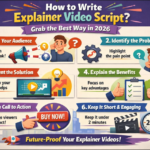
How to write an Explainer Video Script? Grab the Best Way in 2026

In the fast-paced B2B landscape of 2026, the “Clarity Gap” is the greatest enemy of conversion. This gap exists between the sophisticated solution you offer and the prospect’s ability to grasp its value in under 60 seconds. If your audience cannot instantly understand how your product resolves their specific pain point, they move on. At ExplainerCue, after refining over 1,500 projects, we have found that the most effective way to bridge this gap is not through high-budget graphics alone, but through a surgical, high-converting script. Here is how to write an explainer video script that turns complex technical propositions into high-intent revenue. 1. Decoding Your Audience & Value Proposition Before you type a single word, you must define the “Who” and the “Why.” A script written for a CTO requires a different lexicon than one designed for a Marketing Manager. In our experience, the most successful SaaS product demo video services start by anchoring the narrative in a relatable struggle. Do not lead with your features; lead with the transformation your product facilitates in their daily workflow. The 5-Second Hook You have less than five seconds to prevent the “scroll-away.” Your opening must agitate a known industry pain point. 2. Structuring Your Script (The Proven Framework) To effectively write an explainer video script, you need a framework that respects the viewer’s cognitive load. We recommend the 4-Step Narrative Arc: [Placeholder: Insert Case Study/Video here – Highlighting a SaaS onboarding success] 3. Best Practices to Write Explainer Video Script (2026 Edition) Keep It Conversational The biggest mistake we see in corporate scripting is the “textbook trap”—using jargon-heavy sentences that look better on paper than they sound in audio. Read your script aloud. If you stumble over a sentence, your voice-over artist will, too. Visual-Audio Synergy A script is only one-half of the final asset. You must write with the visual in mind. If you are highlighting a data-heavy interface, your script should pace itself to allow the 3D explainer video production agency enough time to showcase the UI elements. For deeper technical products, consider how Industrial automation explainer video strategies use visual cues to offload cognitive burden from the voice-over. 4. The Pro-Tip: Visualizing the Script via Storyboarding A script is the blueprint, but the storyboard is the build. Once your script is finalized, we map it against a visual sequence to ensure pacing. If you are struggling to communicate complex integrations, refer to our guide on Isometric design for tech products to understand how visual perspective can clarify functional hierarchy. For those in the finance or security space, looking at a successful Fintech and DeFi explainer video can offer a blueprint for translating abstract security protocols into trustworthy visuals. Final Thoughts: From Script to Screen Writing a high-authority script is about subtraction—removing everything that doesn’t push the viewer toward a business decision. Whether you are building a PropTech AI-driven platform demo or a Cybersecurity enterprise software video, the goal remains the same: clarity, credibility, and conversion. Don’t let your product’s value get lost in a cluttered script. If you are ready to elevate your video strategy and ensure your brand narrative resonates with your target enterprise audience, we are here to help. Ready to turn your vision into a high-converting motion design asset? Book a strategy audit with ExplainerCue today and let’s bridge your clarity gap. For more insights on optimizing your video content, explore our SaaS animation style guide or analyze common SaaS onboarding mistakes to avoid in your next production.
Best Educational Explainer Videos for 2026 (Pro Guide)

If you are looking for the best educational explainer videos to boost learner retention, you are in the right place. In the modern landscape, the greatest barrier to learning isn’t the subject matter—it is the “Clarity Gap.” This is the fundamental disconnect between complex academic frameworks and a student’s ability to retain that information through static materials. In our experience at ExplainerCue, after working on over 1,500 projects, we have seen that successful institutions are moving away from passive slides. They are using professional motion design to turn abstract concepts into interactive, high-retention visual stories. Why Educational Explainer Videos Are Essential for Modern Learning Traditional “wall-of-text” curriculum leads to cognitive fatigue. To solve this, we must look at the science of how we learn, specifically Cognitive Load Theory. When you use animation to synchronize audio narration with visual representation, you tap into the “Dual Coding” principle—the brain processes verbal and visual information through two distinct channels. Core Styles of Educational Explainer Videos in 2026 Choosing the right aesthetic is critical. Here are the styles dominating the sector this year: 1. 2D Motion Graphics for Conceptual Storytelling 2D animation is perfect for conceptual learning. It is our top recommendation for building an emotional connection with the learner, transforming “boring” academic topics into stories they care about. 2. 3D Visualizations for Depth and Precision When clarity is non-negotiable, our 3D explainer video production agency services are the solution. 3D is the gold standard for scientific processes where perspective and depth are required for accurate understanding—a concept often explored in scientific visualization studies. 3. Whiteboard & Sketch Animation Sometimes, the “human touch” of sketching aids understanding. This style mimics the classic teacher-at-a-chalkboard experience but with the polish of professional digital production. Strategic Use-Cases: Moving Beyond the Classroom Educational explainer videos are vital tools for corporate onboarding, compliance, and professional development. Corporate Compliance and Onboarding Replace “compliance fatigue” with engaging, fast-paced motion modules. When employees understand the why behind a policy through a well-crafted visual story, compliance rates increase. STEM and Technical Education Breaking down STEM topics using visual logic helps students grasp difficult concepts like molecular interactions. By visualizing the invisible, you provide students with a mental model they can hold onto. SaaS and Technical Training Using our SaaS product demo video services to onboard users is the most efficient way to reduce support tickets. By showing the software interface in motion, you guide learners through their first session in minutes, removing the friction associated with new technology. [Placeholder: Insert Case Study/Video here – Showcasing a successful educational animation project] Best Practices for Educational Explainer Design If you are planning to produce high-authority content, keep these four pillars in mind to ensure your project succeeds in 2026: The Future of Interactive Education As we look deeper into 2026, the intersection of interactive elements and motion design is the next frontier. We are seeing educational videos that allow learners to click on elements to trigger deeper explanations. For an institution or a SaaS company, this means moving from “passive watching” to “active learning.” Conclusion: Investing in Learning Outcomes In 2026, the quality of your educational content directly correlates to your learners’ success. Investing in professional motion design is not just a marketing expense; it is an investment in academic retention and operational efficiency. When your learners understand more, they achieve more. Don’t let your curriculum suffer from poor engagement or complex, jargon-heavy presentations. The cost of “average” content is far higher than the investment in “exceptional” content. Are you ready to transform your educational materials into a high-converting, high-retention learning experience? Book a strategy audit with ExplainerCue today and let’s design learning experiences that actually stick.