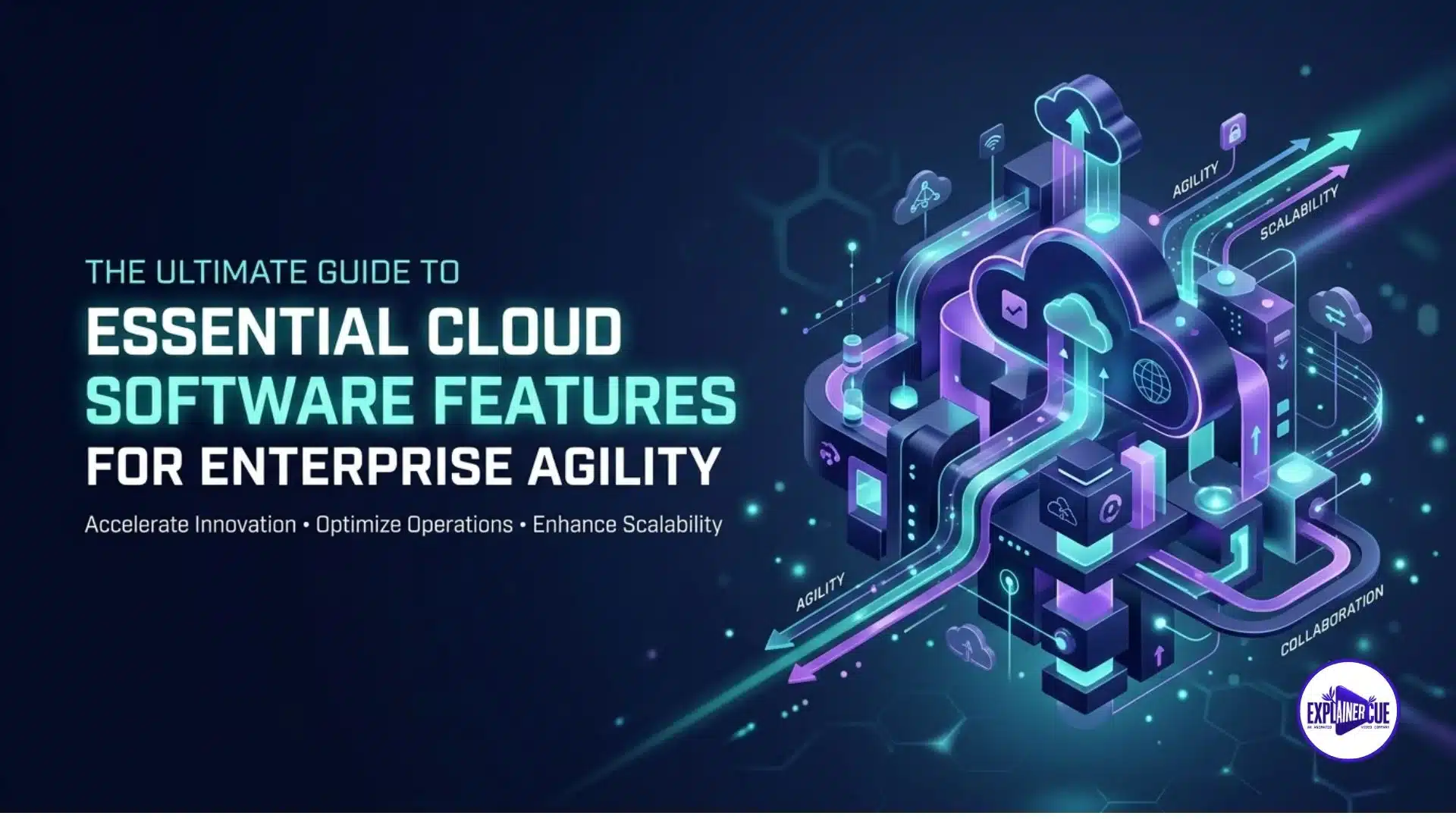
Relying on legacy on-premise infrastructure is slowly suffocating your business agility. When server capacity maxes out, scaling operations becomes a logistical nightmare, and unexpected system downtime bleeds your revenue.
Competitors leveraging modern cloud software features are deploying updates in minutes, leaving your stagnant infrastructure far behind. The solution is migrating to an intelligent, distributed cloud environment.
By adopting the right infrastructure, enterprises can instantly transform operational bottlenecks into automated, high-performing revenue drivers. Let’s explore the non-negotiable capabilities your tech stack needs to scale efficiently.
Table of Contents
Core Cloud-Based Platform Capabilities
The foundation of any modern enterprise is built on flexibility. True cloud-based platform capabilities allow organizations to pivot instantly without the burden of hardware procurement.
To remain competitive, your platform must support API extensibility and microservices. This ensures that third-party integrations, from CRM systems to payment gateways, plug into your ecosystem flawlessly.
Dynamic Resource Allocation
Traffic spikes should never crash your application. One of the most critical elements of modern infrastructure is intelligent load balancing and auto-scaling.
When you leverage scalable cloud architecture benefits, your system automatically provisions new server instances during peak demand. Once the traffic subsides, it spins those resources down, ensuring you only pay for exactly what you consume.
- Key Takeaway: Auto-scaling eliminates the need for expensive, idle backup servers while guaranteeing 99.99% uptime during massive traffic surges.
Unpacking Advanced SaaS Application Functionality
Delivering a software product is no longer just about back-end stability; the end-user interaction matters equally. High-tier SaaS application functionality relies on multi-tenant architecture, allowing thousands of users to share a single, secure instance of the software.
This centralized approach means continuous integration and continuous deployment (CI/CD) pipelines can push bug fixes globally in seconds. It completely removes the friction of forcing clients to download manual patches.
To truly understand why this user-centric operational model is so vital for retention, you need to grasp the essence of seamless software architectures. A flawless front-end experience is heavily dictated by robust backend architecture.
The Imperative of Secure Cloud Computing Solutions
Data breaches in the enterprise sector cost millions in compliance fines and lost customer trust. Therefore, migrating data off-premise requires uncompromising, secure cloud computing solutions.
The modern standard is a Zero-Trust architecture. This means the system assumes every access request is a potential threat, requiring strict identity and access management (IAM) verification before granting entry.
Furthermore, leading cloud environments ensure continuous compliance with SOC2, GDPR, and HIPAA standards.
- End-to-End Encryption: All data must be encrypted both in transit and at rest to prevent unauthorized interception.
- Automated Threat Detection: Utilizing AI-driven security protocols to instantly isolate compromised nodes before a breach spreads.
- Disaster Recovery: Automated geographic backups ensure that if one data center goes offline, a secondary site takes over immediately.
Conclusion
Migrating to the cloud is no longer a futuristic goal; it is an immediate operational necessity. By prioritizing essential cloud software features like auto-scaling, multi-tenancy, and Zero-Trust security, you future-proof your entire organization.
These architectural upgrades eliminate manual maintenance, reduce long-term costs, and empower your engineering teams to focus on building innovative products rather than managing servers.
Is your infrastructure holding back your growth? Audit your current tech stack today and map out a strategic migration plan to unlock the full potential of cloud-native agility.