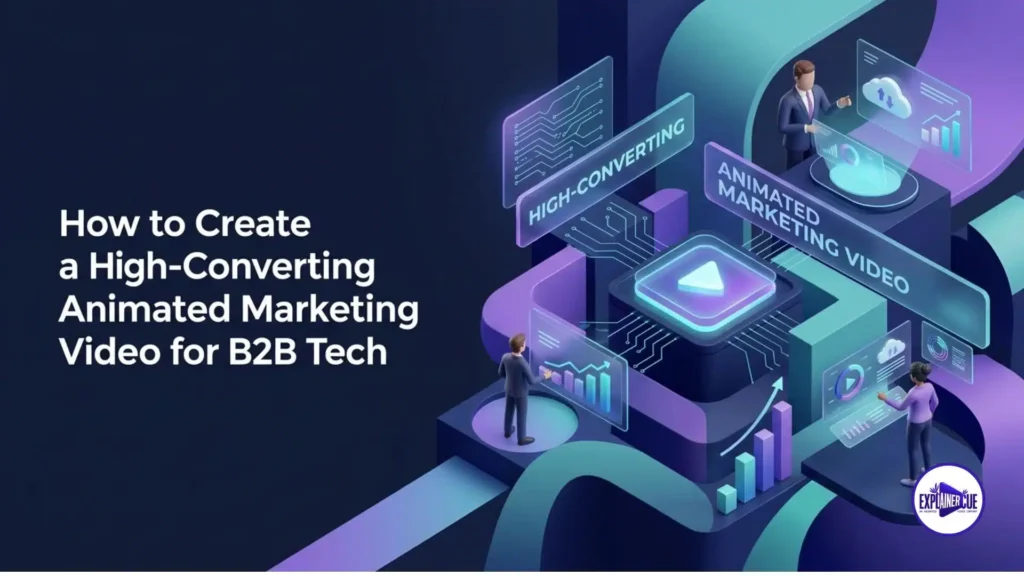
An animated marketing video uses animation — rather than filmed footage — to grab attention and explain a product or offer quickly across ads, social, and landing pages. Animation wins in marketing for a simple reason: it can show anything, change instantly, and stop a scroll in the first second, without the cost and rigidity of a live shoot.
This guide covers where animated marketing videos beat live action, the main types and where each belongs, and how to brief one that performs instead of just looking polished.
Why animation wins in marketing
Marketing video has three hard constraints: you have about one second to earn attention, the message must land without sound (most feeds autoplay muted), and you will want to change or localise it later. Animation handles all three better than filming. It can open on a bold visual hook, carry meaning through motion and on-screen text, and be edited in the file rather than reshot. That flexibility is why so much high-performing paid social is animated.
Animated vs live action for marketing
| Animated | Live action | |
|---|---|---|
| Can show | Anything — concepts, data, the invisible | Only what you can film |
| Changes / localisation | Edit in the file | Reshoot |
| Attention hook | Instant visual control | Depends on footage |
| Best for | Products, SaaS, complex offers | Human, testimonial, real-world trust |
Neither is “better” — they win different jobs. For a human, trust-led message, live action is right. For explaining a product or stopping a scroll, animation usually wins.
Types of animated marketing video
- Explainer — the workhorse; explains the offer on landing pages and in ads.
- Social / ad cuts — 6–15 second hooks built for feeds.
- Product & launch videos — build interest around what is new.
- Motion graphics — animated data, stats, and kinetic text for campaigns.
In a muted, thumb-scrolling feed, your first frame is the whole ad. Animation gives you total control over that frame — filming rarely does.
Bilal Ali, Founder & Creative Director, ExplainerCue
An animated marketing video example
How to brief one that performs
- Design for sound-off — the message must work with captions and motion alone.
- Hook in the first second — lead with the boldest visual, not a logo.
- One offer, one action — cut anything that does not serve it.
- Order the cut-downs up front — feed, story, and square versions from one master.
Animated marketing videos are only as good as the plan behind them — pair this with a clear video marketing strategy so each one has a job. When you are ready to produce, get a custom quote and we will recommend the right formats for your campaign.
Faq’s
Q1: What is an animated marketing video?
A marketing video that uses animation instead of filmed footage to grab attention and explain a product or offer quickly across ads, social, and landing pages. It can show anything and is easy to edit or localise.
Q2: Is animation or live action better for marketing?
They win different jobs. Animation is better for explaining products, showing concepts, and stopping a scroll; live action is better for human, testimonial, and real-world trust messages. Many campaigns use both.
Q3: What types of animated marketing videos are there?
Common types include explainer videos, short social and ad cuts, product and launch videos, and motion graphics for data and kinetic text. Each fits a different placement in a campaign.
Q4: How much does an animated marketing video cost?
ExplainerCue’s pricing is $1,000 (30s), $2,000 (60s), and $3,000 (90s), with cut-downs for ads and social built from one master to stretch the budget across placements.
Last updated August 11, 2026

Syed Bilal Ali (Bill)
I’m Syed Bilal Ali (Bill), Founder and Creative Director at ExplainerCue. I help B2B brands explain complex ideas through high-impact motion graphics and 3D animation. Here, I write about video marketing strategies, animation trends, and creative execution.
More articles by Syed Bilal Ali (Bill) →Need a video that explains your product?
3,100+ B2B explainer, isometric and 3D videos delivered since 2018.
Get a custom quote