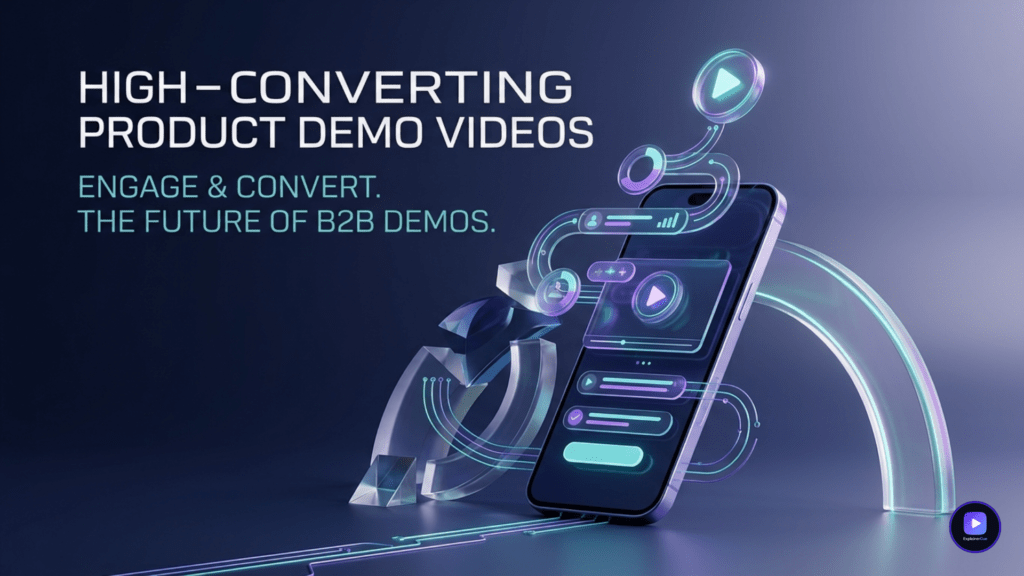
A product demo video shows your product actually working — real or animated UI, screens, clicks, and workflows — to help a buyer evaluate it. Unlike an explainer video, which sells the outcome in a short story, a demo shows the product itself, and is aimed at buyers who are already further along in their decision.
Confusing the two is the most common reason a product video underperforms. This guide covers the difference, the types of demo, what makes one convert, and the choice that matters most — animated UI versus screen recording.
Product demo video vs explainer video
An explainer video answers “why should I care?” in 60–90 seconds. A demo answers “how does it actually work, and will it fit my use case?” for someone who already cares. Explainers live at the top of the funnel; demos live in the middle and bottom. Most software teams need both — and the strongest results come from building them from one script, so the message stays consistent as the buyer moves from curiosity to evaluation.
| Explainer video | Product demo video | |
|---|---|---|
| Answers | “Why should I care?” | “How does it work for me?” |
| Funnel stage | Top (awareness) | Middle / bottom (evaluation) |
| Length | 60–90 seconds | 60 seconds to 5 minutes |
| Shows | The outcome & value | The actual product & UI |
The main types of product demo video
- Overview demo — a short, polished tour of the core value; often on the homepage or in ads.
- Sales demo — longer and tailored to a use case; used in decks and follow-ups.
- Self-serve / interactive demo — lets prospects explore at their own pace.
- Onboarding demo — short feature videos that get new users to value and cut churn.
What makes a good demo video
A good demo resists the urge to show everything. It picks the two or three moments where your product visibly does something the buyer could not do before, and spends its time there. It uses clean, animated UI rather than laggy screen recordings, so the interface looks its best and stays legible. And it is built to be updated — because your product will change, and a demo that is out of date is worse than none.
A demo is not a feature tour. It is proof — you are showing the two moments where the buyer thinks “oh, that is the thing I could not do before.”
Animated UI vs screen recording
Screen recordings are fast and cheap, but they age badly, show every rough edge, and cannot highlight what matters. Animated UI — recreating your interface as clean motion — costs more, but it looks sharp, directs the eye to the right element, and is easy to localise or update. For complex or data-heavy products, we often pair it with isometric animation to show how the system connects behind the screen.
A SaaS demo example
How long should a demo video be?
An overview demo works best at 60–90 seconds; a sales or walkthrough demo can run 2–5 minutes for an opted-in audience. For the full breakdown by placement, see our guide to explainer video length. Want a demo that shows your product at its best? Get a custom quote and we will recommend the right approach.
Faq’s
Q1: What is a product demo video?
A product demo video shows your product actually working — real or animated UI, screens, and workflows — to help buyers evaluate it. It targets people further along in the buying decision than a top-of-funnel explainer.
Q2: What is the difference between a demo video and an explainer video?
An explainer sells the outcome and value in a short story for first-touch awareness. A demo shows the product itself — screens, clicks, and workflows — for buyers evaluating it. Many teams use both.
Q3: How long should a product demo video be?
An overview demo works best at 60 to 90 seconds. A detailed sales or walkthrough demo can run 2 to 5 minutes because the viewer has opted in.
Q4: Should I use animated UI or a screen recording?
Animated UI looks sharper, directs attention, and is easy to update, but costs more. Screen recordings are cheaper and faster but age badly. For a flagship demo, animated UI usually wins.
Last updated August 11, 2026

Syed Bilal Ali (Bill)
I’m Syed Bilal Ali (Bill), Founder and Creative Director at ExplainerCue. I help B2B brands explain complex ideas through high-impact motion graphics and 3D animation. Here, I write about video marketing strategies, animation trends, and creative execution.
More articles by Syed Bilal Ali (Bill) →Need a video that explains your product?
3,100+ B2B explainer, isometric and 3D videos delivered since 2018.
Get a custom quote